STG Logistics Survey Finds Shippers Prioritizing Optionality Heading Into 2027
Amid rising costs and uncertainty, shippers are preserving flexibility across providers, transportation modes, and inventory strategies
COLUMBUS, OH, Oct. 26, 2026 — With rising transportation costs and continuing market uncertainty, U.S. shippers are heading into 2027 focused on maintaining options across their supply chains, according to a new survey from STG Logistics, one of the nation’s largest providers of integrated port-to-door services and supply chain solutions.
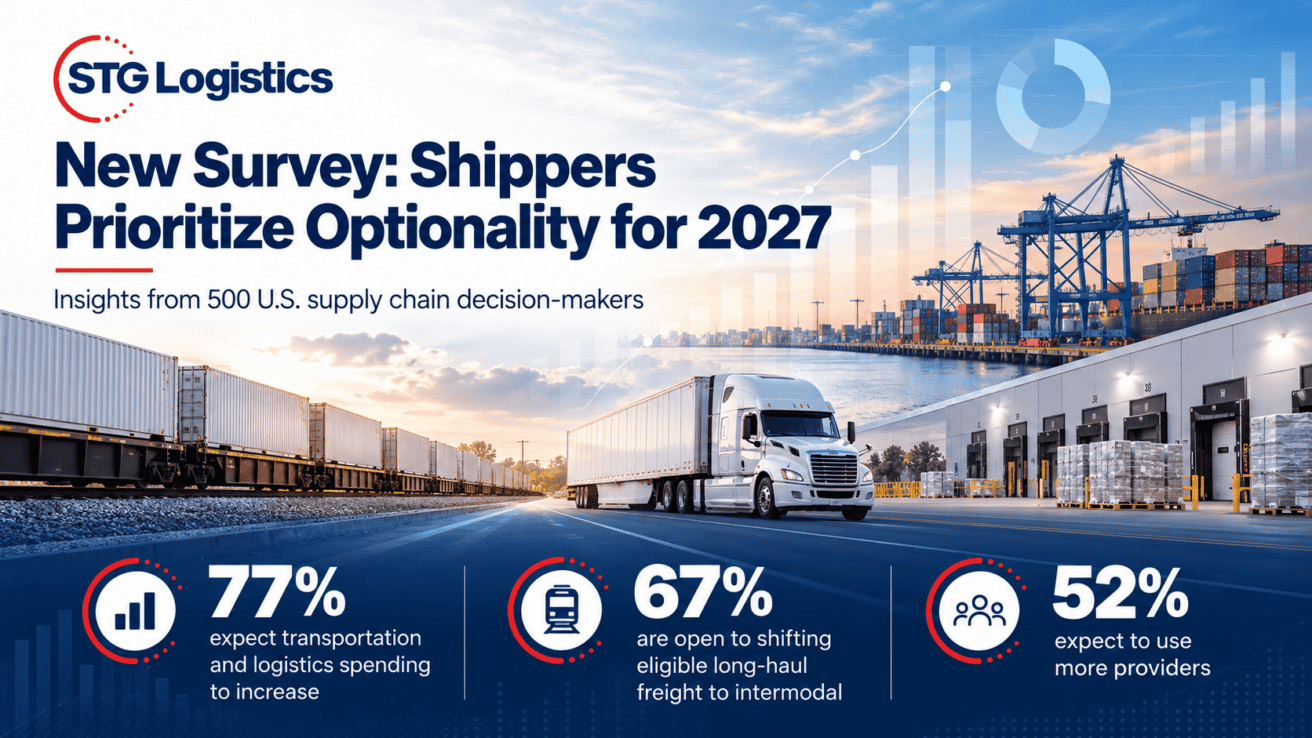
The survey of 500 U.S. transportation, logistics, and supply chain decision-makers at companies with annual revenue of $100 million or more found that 77% expect transportation and logistics spending to increase in 2027. Fuel is the most widely cited cost concern, while tariffs and trade policy are expected to have the greatest impact on inventory strategy and logistics strategies more broadly.
“Shippers aren’t betting on a single answer for 2027. They’re keeping their options open across providers, modes, and inventory, because the companies that come out ahead will be the ones that can adjust fastest as costs and conditions change,” said Jack Holmes, CEO of STG Logistics. “At STG, we’re positioned to help customers navigate that uncertainty with an integrated port-to-door platform, a clean and healthy balance sheet, and the financial strength to continue investing in our people, capabilities, and service. That combination gives our customers the flexibility they need and the confidence to plan for what’s next.”
That desire for optionality is especially clear in provider relationships. More than half of respondents (52%) expect to increase the number of transportation and logistics providers they use next year. At the same time, shippers are nearly evenly divided between preferring a smaller group of multi-service providers (38%) and multiple specialized providers (36%), suggesting there is no single approach to building the right provider mix.
Shippers are taking a similar approach to transportation modes. Two-thirds (67%) are open to shifting eligible long-haul freight from truckload to intermodal, and 63% expect their intermodal use to increase. But the economics have to work: nearly half (49%) require savings of at least 10% to make the shift. Meanwhile, more respondents expect increases than decreases across every mode, led by truckload (79%) and dedicated (69%), reinforcing that shippers are diversifying rather than replacing one mode with another.
“As capacity continues to tighten shippers are expanding their networks, and the more options they incorporate, the more coordination it takes to make it all work,” said Vince Paperiello, EVP and Group President, Transportation. “Whether it’s determining where intermodal fits best, shifting freight to larger, lower-risk brokers, or positioning inventory closer to customers, the goal is to provide shippers with flexible solutions while keeping operations simple.”
Inventory is also becoming part of the equation. More than half (52%) expect to carry more inventory in 2027, while 41% anticipate adding warehouse capacity, and 33% plan to reposition inventory closer to customers.
Taken together, the findings show shippers are not converging around a single response to higher costs and uncertainty. Instead, they are expanding their mix of providers, modes, and inventory strategies to preserve the ability to adapt, making optionality a defining theme for supply chains in 2027.
About STG Logistics
STG Logistics, Inc. is a leading integrated multimodal transportation and logistics provider offering asset-based intermodal, marine and rail drayage, and full and less-than-truckload transportation together with industry-leading warehousing and transloading services. With 40 years of experience in domestic logistics, STG services every major rail ramp and port in the country.